
Quick answer: Bitcoin Up or Down 5 minutes is a prediction market that asks one question every five minutes: will Bitcoin's price be at or above its starting price when the five minutes end? You buy "Up" or "Down" shares priced between 1¢ and 99¢, which reflects how likely traders think each side is. Every winning share pays $1. If your side loses, you lose what you paid.
What is Bitcoin Up or Down 5 minutes?
It is a series of short prediction markets about Bitcoin's price direction. A new round opens every five minutes, all day, and each one settles on its own.
Each round has one number that matters: the price to beat, which is Bitcoin's price at the moment the round opens. When the five minutes are up, the round is decided against that number. If Bitcoin is at or above it, Up wins. If it is below, Down wins.
Swipa puts these rounds in Telegram and on the web: you pick a side and an amount, see what you could win before you buy, and winnings are collected for you automatically.
Bitcoin Up or Down right now
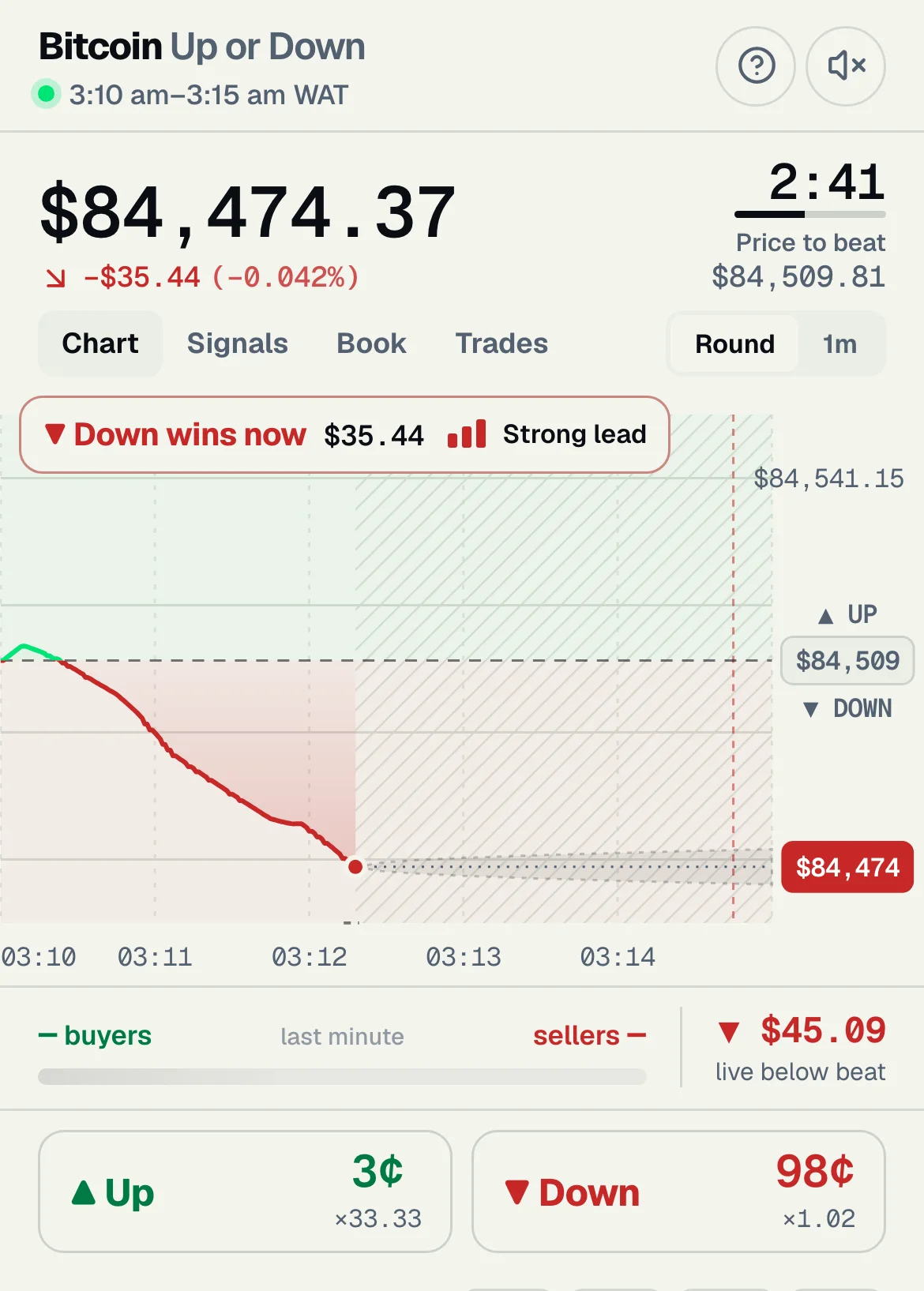
The card at the top of this page is the round that is live right now. It shows Bitcoin's price against the price to beat, the time left, and what Up and Down cost at this moment. It updates every few seconds. When a round ends, the next one appears.
Read it like this: if Bitcoin is above the price to beat with little time left, Up gets expensive and Down gets cheap, because the market thinks Up will probably win. The price of each side is the market's live estimate of its chances.
How a round works, minute by minute
- 0:00Round opensBitcoin's price is recorded as the price to beat.
- 0:00–4:30Buy Up or DownShare prices move every second as Bitcoin moves.
- 4:30New buys stop on SwipaSo no order can arrive after the round closes.
- 5:00Round closesThe result is checked against the price to beat.
- +1–2 minYou get paidWinning shares pay $1 each, straight into your balance.
How the result is decided
Each round resolves Up if Bitcoin's price at the end of the window is greater than or equal to the price at the start, and Down otherwise.
The price does not come from any single exchange. The rules use Chainlink's BTC/USD data stream, a time-weighted average price (TWAP) feed built from many sources, so one exchange's odd spike can't decide a round on its own.
- A tie counts as Up. "Greater than or equal to" means an unchanged price is an Up win.
- Your exchange's chart can differ slightly. Chainlink's number can be a few dollars away from the one on your favourite app.
How the odds work
The price of a share is the market's estimate of the chance that side wins.
- If Up costs 62¢, traders think there is about a 62% chance Bitcoin finishes at or above the price to beat.
- Up and Down add up to about $1. If Up is 62¢, Down is close to 38¢.
- Cheap shares pay more but win less. A 20¢ share pays five times your money if it wins, but the market thinks it wins about one time in five.
How much can you win?
Pick a side and an amount below. The calculator uses the current share price when available and estimates buy, market trading and winnings fees. It is an illustration, not an executable quote: actual fills, rounding and prices can differ. Move the slider to see how the estimated payout changes at other prices.
If Up costs 60¢ and you put in $10, you get about 16.1 shares. If Up wins you receive about $15.47 (profit about $5.47) after all fees. If Down wins, you lose the $10.
Why 95¢ shares are not free money
Near the end of a round, one side often trades at 90¢ or more. It looks safe, but look at $10 on a 95¢ share:
- You get about 10.4 shares.
- If you win, you receive about $10.44, a profit of roughly 44¢. (Swipa's winnings fee is skipped on small profits like this.)
- If Bitcoin flips in the last minute, you lose $10.
You are risking $10 to make about 44¢. One wrong call wipes out more than twenty right ones, and Bitcoin can move sharply inside a single minute.
Live trades on this round
Real, anonymous buys on the current round as they happen. Each share pays $1 if its side wins.
Live trades on the current round load here.
Bitcoin Up or Down strategy: what actually matters
No strategy wins every round, and anyone selling a "sure" system or signal is selling you something. These are the things that genuinely affect your odds:
- The gap and the time left, together. Bitcoin $20 above the price to beat means much more with 30 seconds left than with 4 minutes left.
- The price already includes what you can see. If Up is 80¢, the market has already priced in Bitcoin being ahead. You only profit when the market is wrong, not when you are merely right about the obvious.
- Near-certain sides pay little. As shown above, a 95¢ share risks a lot to win a little.
- Big moves happen in seconds. Liquidations and news can move Bitcoin $50 or more inside a minute.
- A budget beats a system. Decide how much you will use before you start, and stop when it is gone.
What it costs
| Fee | How much | When |
|---|---|---|
| Swipa buy fee | 0.5% of what you put in | Every buy |
| Market trading fee | 7% × price × (1 − price) per share: about 1.75¢ per share at 50¢, less near 1¢ or 99¢ | Every buy, included in the price |
| Swipa winnings fee | 4.1% of a winning payout | Only on wins, skipped when the profit is small |
There is no fee to hold a position, and a losing round costs nothing beyond what you put in.
Can you trade Bitcoin Up or Down in Nigeria?
Swipa offers these calls in Telegram and on the web, subject to account and location eligibility. You add money as USDC on the Polygon network (see how to buy USDC in Nigeria), and your trading location must be verified before buying.
Nigeria's SEC regulates crypto exchanges but has not issued specific rules for prediction markets, so check that using them suits your own situation.
Prices, results and your balance
- Share prices reflect bids and offers from traders, not a guaranteed return.
- Chainlink provides the Bitcoin reference price used to decide each round.
- Swipa shows the round, lets you place your call, and collects confirmed winnings into your balance automatically.
- Settlement records can be checked on the Polygon blockchain. A round ending is not the same as a payout being confirmed.
Risks to know
- You can lose your whole stake on every call. A round has only two outcomes.
- Five minutes is noisy. Short-term Bitcoin moves are hard to predict, even for professionals.
- Chasing losses is the fastest way to lose more. Decide how much you will use before you start, and stop when it's gone.
- Only use money you can afford to lose. Nothing here is financial advice.
Frequently asked questions
What does “Bitcoin Up or Down” mean on Polymarket?
On Polymarket, the phrase refers to prediction markets about whether Bitcoin finishes a specified period at or above a reference price. This is a general explanation of that platform's market category, not a guarantee of profit. Check the rules, fees, availability and resolution source for the particular market you are considering.
What time do the rounds start?
Every five minutes, around the clock: 10:00, 10:05, 10:10 and so on. Swipa shows each round's window in Lagos time.
What is the difference between the 5-minute and 15-minute markets?
The main difference is the time window. A 15-minute round leaves more time for the price to change, but neither length guarantees a better chance of profit. Check each market's rules and fees separately. Swipa focuses on 5-minute rounds.
What happens if the price ends exactly where it started?
The round resolves Up. The rule is "greater than or equal to" the start price, so a tie goes to Up.
Can I sell before the round ends?
Yes, if you hold at least 5 shares: you can sell at the current price before the round ends. Smaller positions are held to the end and settle automatically.
How fast do I get paid if I win?
Usually within a couple of minutes after the round closes. Swipa collects your winnings into your balance automatically; you don't need to claim them.
What is the smallest amount I can use?
About $1. The app shows the current minimum, including fees, in your currency before you buy.
Sources
- Chainlink BTC/USD TWAP data stream
- General market background: CoinMarketCap: Polymarket debuts 5-minute Bitcoin prediction markets
- Swipa fee schedule and settlement times, as shown in the app on 27 September 2026.